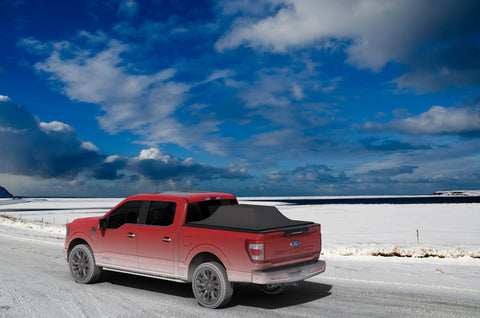
What Is the Ford F-150 Lightning? Specs, History, Orders, and Cargo Utility
The Ford F-150 Lightning is one of the most important electric pickup trucks ever released because it did something simple and bold: it put electric power into America’s best-known pickup platform.
Ford did not try to make the Lightning look like a spaceship. It looked like an F-150, drove like a truck, carried gear like a truck, and gave pickup owners a familiar bed, cab, and work-ready layout.
That is why the Lightning got so much attention. It was not just an EV story. It was a truck story.
For pickup owners, the bigger question is not only “What is the Ford F-150 Lightning?” It is also “How do I make the bed more useful after I buy one?”
This guide covers the Lightning’s key features, launch history, reservation story, specs, cargo utility, and why F-150 Lightning owners should think carefully about tonneau covers, truck bed covers, caps, and Adaptive Cargo Management Systems.

Courtesy of the Ford Motor Company
Quick Answer: What Is the Ford F-150 Lightning?
The Ford F-150 Lightning is an all-electric version of the Ford F-150 pickup truck.
Instead of a gasoline engine, it uses electric motors and a rechargeable battery. Depending on model year, trim, battery, and package, the Lightning can offer four-wheel drive, strong acceleration, available extended range, serious towing capability, a large front trunk, and onboard power for tools, appliances, camping, tailgating, and backup needs.
The official Ford F-150 Lightning page is the best place to check current specifications, trims, range estimates, towing ratings, and availability.
Why the F-150 Lightning Got So Much Attention
Electric cars were already familiar before the Lightning arrived. Electric pickup trucks were different.
Pickup owners are practical. They care about towing, payload, bed access, charging, bad weather, work capability, road trips, and whether the truck can actually handle a normal week of use.
The Lightning got attention because Ford took a familiar F-150 shape and added electric torque, quiet operation, a large battery, a usable bed, and practical power-export features.
For more Ford video content, see Ford’s official F-150 Lightning YouTube playlist.
F-150 Lightning: Launch, Reservation, and Order History
The launch history is worth keeping because it shows how much attention the Lightning created when Ford announced it.
When Ford opened reservations, the response was huge. Ford later reported that the Lightning had reached 200,000 reservations, and that three out of four reservation holders were new to Ford.
That matters because the Lightning was not only appealing to existing F-150 owners. It was pulling in new customers, first-time truck buyers, EV shoppers, business owners, and people who wanted an electric truck that still felt familiar.
Ford also made a smart strategic choice by building the Lightning around the F-150 platform. That meant buyers were not looking at a strange niche vehicle. They were looking at an electric version of a truck they already understood.
You can read Ford’s own launch coverage here: America’s Best Selling Vehicle Now Electric: Production Begins for F-150 Lightning.
Ford F-150 Lightning Specs That Matter
Specs vary by model year, trim, battery, package, and configuration, so shoppers should always check Ford’s current information before buying.
Still, there are several Lightning features that explain why the truck became such a big deal.
Electric Range
Ford has listed F-150 Lightning models with EPA-estimated range up to 320 miles, depending on battery and trim.
For daily driving, jobsite use, commuting, errands, and local outdoor trips, that can be plenty. For long-distance towing, cold-weather driving, mountain routes, and remote travel, range planning matters more.
Towing Capability
The Lightning is still built around truck utility, and towing is part of that story.
Ford has listed available towing capacity up to 10,000 pounds on certain Lightning models when properly equipped with the available Max Trailer Tow Package.
That is strong capability, but EV truck buyers need to be realistic. Towing can reduce range. If you tow often, especially at highway speed, plan around trailer weight, charging stops, weather, road grade, and speed.
Four-Wheel Drive
Ford has listed four-wheel drive across the Lightning lineup.
That fits how pickup owners use trucks. Rain, snow, boat ramps, worksites, dirt roads, campgrounds, and winter errands all make traction important.

Smooth Power Without a Gas Engine
Electric trucks feel different from gas trucks.
There is no engine revving through gears. Torque arrives quickly. Acceleration feels immediate. The ride is quieter. For someone used to a gas F-150, the first hard launch in a Lightning can feel almost suspiciously smooth.
The U.S. Department of Energy’s Alternative Fuels Data Center explains that all-electric vehicles use batteries charged by plugging into charging equipment and operate in all-electric mode.
For general EV background, see the Alternative Fuels Data Center guide to electric vehicles.

Power for Tools, Tailgates, Camping, and Backup Needs
One of the Lightning’s most useful features is power export.
Ford has listed available Pro Power Onboard with up to 9.6 kW of power. That can matter for contractors, campers, tailgaters, emergency use, and anyone who has ever wished their truck could power more than a phone charger.
Real-World Uses
- Jobsite: Power tools, chargers, lights, and small equipment.
- Camping: Run lights, appliances, air pumps, and outdoor gear.
- Tailgating: Power speakers, coolers, cooking gear, and screens.
- Emergency use: Help power essentials when properly equipped.
That is one of the reasons the Lightning is interesting. It is not only transportation. It can also act like a rolling power station.

The Mega Power Frunk
The Lightning has one feature gas F-150 owners do not get: a front trunk.
Ford calls it the Mega Power Frunk. Since there is no gasoline engine under the hood, Ford uses that space for lockable, water-resistant storage.
Ford lists the frunk at 14.1 cubic feet with up to 400 pounds of capacity. That makes it useful for groceries, luggage, charging cables, tools, sports gear, emergency supplies, and anything you want separated from the truck bed.
That is a clever feature because it solves a normal pickup problem. Sometimes you want protected storage without putting everything in the cab.

Smart Truck Features
The Lightning also leans heavily into technology.
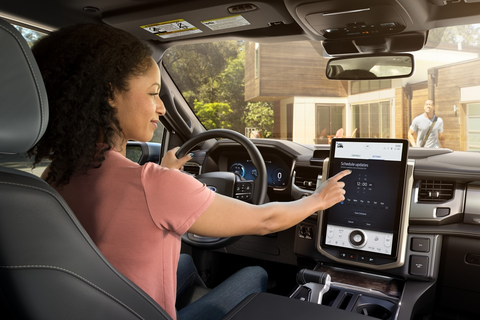
Depending on trim and options, shoppers may find large digital displays, route and range tools, towing software, driver-assist technology, over-the-air updates, and other smart truck features.
Those tools matter more in an EV truck because range, payload, towing, charging, and temperature are all connected.
Features Truck Buyers Should Understand
- Range estimates: Helpful, but still affected by speed, weather, towing, payload, and terrain.
- Payload awareness: Important because truck owners rarely drive empty forever.
- Charging planning: More important for road trips and towing than daily commuting.
- Software updates: Useful as Ford refines vehicle features over time.
The Lightning Name Has History
The Lightning name did not begin with the electric truck.
Ford used the F-150 Lightning name in the 1990s and early 2000s for high-performance F-Series trucks. Those earlier Lightning models were gasoline-powered performance pickups, not electric vehicles.
That makes the modern name clever. Ford took a performance name from the past and applied it to electric torque, instant response, and a new kind of truck capability.
The story also connects to a much older Ford thread. Henry Ford explored electric vehicle ideas in the early days of the automobile, long before modern batteries made a full-size electric pickup practical.


Courtesy of Rutgers School of Arts and Sciences
How the Lightning Fits the EV Truck Market
The electric pickup market has changed a lot since the original Lightning reveal.
Buyers compare EV trucks based on price, range, charging, towing, payload, dealer support, service access, software, and accessory compatibility.
That last point matters more than people think.
Because the Lightning is built around the F-150 platform, many truck owners see it as easier to understand than more unusual EV truck designs. It still looks and works like a pickup. It still has a recognizable bed. It still needs practical accessories.

Why Cargo Management Still Matters on an Electric Truck
The Lightning may be electric, but the bed still has the same basic pickup problem.
You need to protect and secure cargo.
A flat tonneau cover or truck bed cover can work when everything stays below the bed rails. That is useful for luggage, small tools, duffel bags, groceries, and low storage bins.
But F-150 owners do not always haul flat cargo.
- Coolers stick up.
- Generators sit tall.
- Camping gear stacks unevenly.
- Toolboxes and totes rise above the rails.
- Bikes, outdoor gear, and jobsite materials rarely fit neatly under a flat surface.
When that happens, a flat system has to be folded, rolled, retracted, removed, or left open.
That means your cargo is exposed again.
For more background, read Top 5 Tonneau Cover Benefits and Best Tonneau Covers for Ford F-150.
Where Sawtooth STRETCH Fits
Sawtooth STRETCH is not a tonneau cover. It is an Adaptive Cargo Management System, or ACMS.
That distinction matters for F-150 and F-150 Lightning owners.
Tonneau covers and truck bed covers are flat systems. Flat systems only work when cargo stays below the bed rails.
Sawtooth STRETCH is designed to protect and secure both small and large cargo. It can sit lower when your load is small, then adapt over taller, bulkier, and more irregular cargo that flat systems cannot continue to cover.
Why Lightning Owners Should Care
- More cargo flexibility: The bed stays useful across more loading situations.
- Alternative to caps: You get adaptive cargo protection without committing to a fixed-height shell.
- Works for real truck use: Camping gear, tools, coolers, totes, and equipment do not always stay low.
- Better use of the truck: An electric F-150 still needs smart cargo management.
For Ford truck applications, see Sawtooth STRETCH for the Ford F-150, Ford Ranger, and Ford Maverick.
For a deeper comparison between fixed-height enclosed space and bed-cover options, read Tonneau Covers vs. Caps.
The Bottom Line
The Ford F-150 Lightning matters because it brought electric power into a truck platform millions of Americans already understood.
It offers electric torque, available extended range, useful towing capability, onboard power, a large frunk, and smart truck technology.
The launch and reservation history is part of what made it exciting. It showed that truck buyers were at least curious about electric pickups when the right brand, shape, and capability came together.
But after the excitement of electric power, the bed still has to work.
If your cargo usually stays below the rails, a flat truck bed cover may be enough. If you want fixed-height enclosed space, a cap may make sense. But if you want more versatility from an F-150 or F-150 Lightning, Sawtooth STRETCH ACMS gives you a more adaptive way to protect and secure cargo.
Browse available applications on the All Products page, or review common questions on the Sawtooth FAQs page.
Load more. Haul more. Do more.